Fuel cycle
Although transport is not part of the process involved in the transformation of fuel, it is an integral part of the fuel cycle.
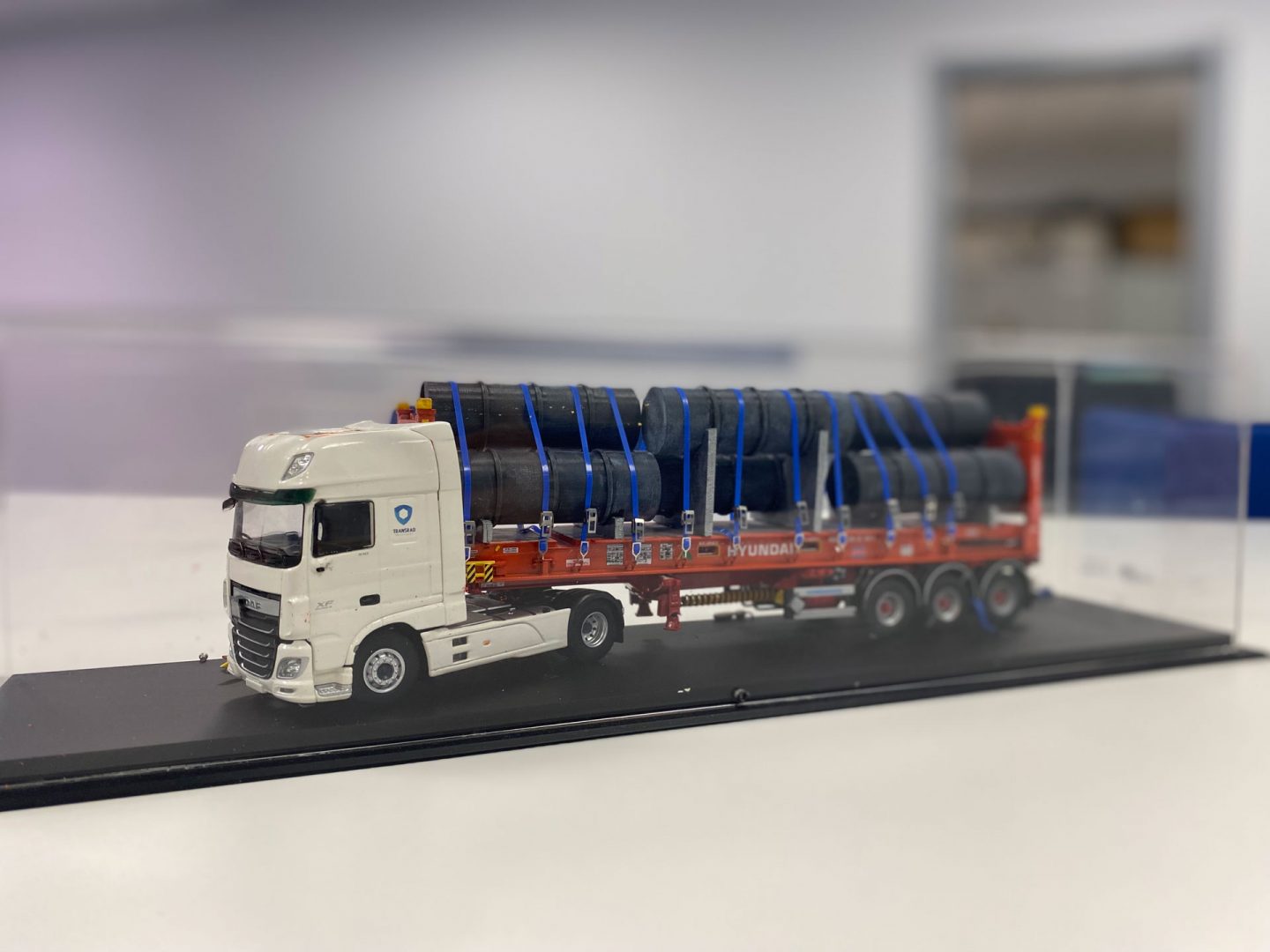
Although transport is not part of the process involved in the transformation of fuel, it is an integral part of the fuel cycle.
Radioactive materials are transported in their solid form. Moving new and spent assemblies, as well as radioactive materials and waste, requires specific packaging designed for this purpose.
The restrictions associated with radioactivity vary according to what the materials are used for. Although fresh uranium fuel assemblies do not emit much radiation and do not need to be shielded, the spent fuel, as well as high-level waste, require specific precautions.
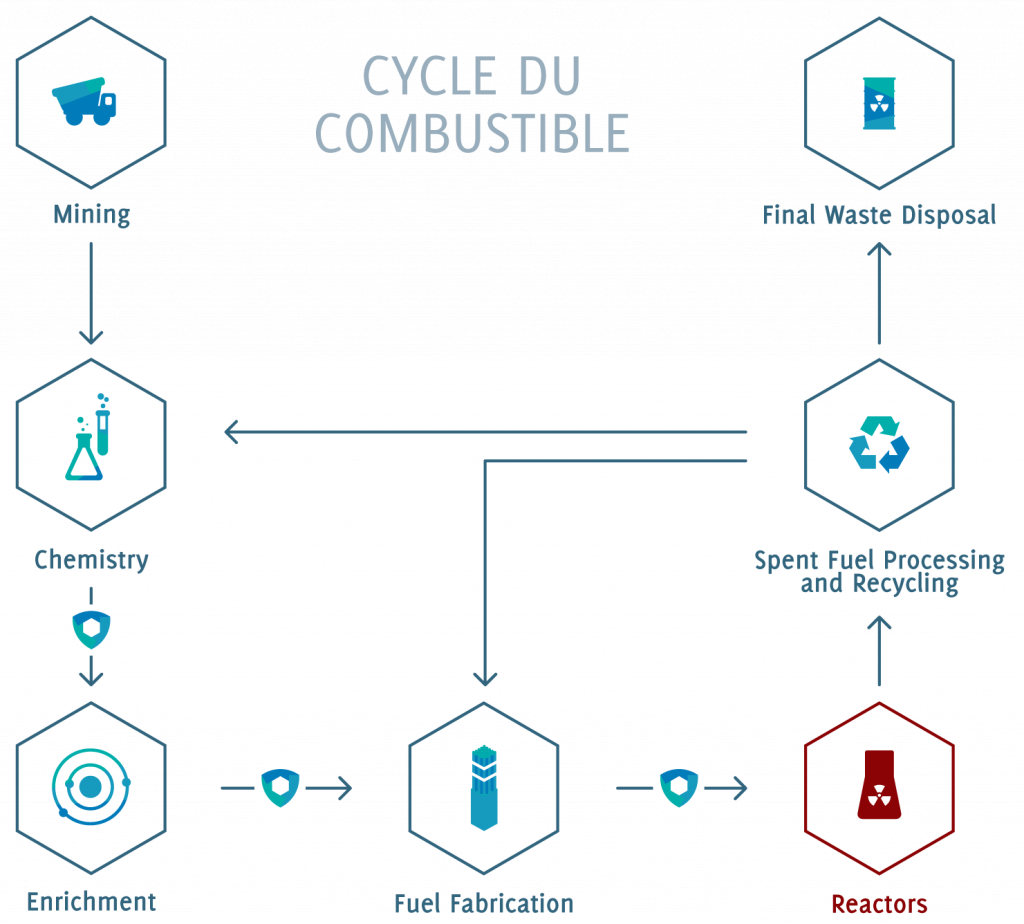
It all begins in the mine from which the uranium is extracted. The ore is crushed, ground and then impregnated with an oxidising acid solution to dissolve the uranium to a level of a few grams per litre. The uranium is then selectively extracted from the solution using a specific molecule, which has been used since the 1970s. This is a followed by a series of purification stages, before a uranium concentrate is produced, called yellowcake (U3O8).
There is another mining method that is used called in situ leaching. When the geology is favourable, excavation is unnecessary: uranium is recovered directly by injecting an oxidising acid solution into the deposit and then pumping out the solution. Here again, researchers are trying to eliminate the different purification stages by improving the method of extraction, which involves passing the solution that comes to the surface over an ion-exchange resin.
In different plants around the world, yellowcake (U3O8) goes through an additional purification process before it is converted into uranium tetrafluoride (UF4), which is then turned into uranium hexafluoride (UF6) thanks to a reaction with fluorine. Next comes the enrichment stage, during which the natural UF6 molecules formed either with isotope U-238 or with isotope U-235 are gradually separated from each other, to produce a UF6 fraction which is enriched in isotope U-235 and a fraction that is depleted (0.2 to 0.3% U-235). The first enrichment plants used gas diffusion. Today, gas centrifugation technology, consuming between 40 and 50% less energy, is used. Once enriched, the UF6 is once again converted into solid uranium oxide (UO2), which is used to make fuels.
The uranium oxide (UO2) is then compressed into pellets at a high temperature. These pellets are then inserted into metal tubes (fuel rods). The fuel rods produced are in turn put together to create a fuel element or fuel assembly.
Fuel assemblies are transported to nuclear power plants around the world, where they are used in a nuclear fission process to produce electricity.
The steps in the back end of the cycle involve managing the radioactive materials produced by the irradiation of the fuel. This includes the physical and chemical transformation of the irradiated fuel, as well as the short- and long-term management of radioactive waste. The radioactivity of the materials during this time emits ionising radiation, as well as a great deal of heat, which restricts all of the processes involved.
The fuel discharged from reactors produces high levels of gamma and neutron radiation, because it continues a significant proportion of incredibly active short-lived fission products. The radioactive decay of these elements also produces a great deal of heat. The first stage in this part of the cycle therefore involves managing the radiation and heat produced by the assemblies until radioactive decay makes the elements with the shortest life disappear.
The fuel is first stored in the power plant in the dedicated pool in the fuel building. The water provides protection against radiation and acts as a heat sink. The fuel is stored in water for at least a few years to reduce the most active isotopes, whose lifetime is shorter than this. The irradiated fuel is thus easier to transport.
The second stage involves storing the irradiated fuel at a dedicated site. This helps to manage the flows and heat before permanent storage or processing. This interim storage usually involves a storage pond. Dry storage (in air or in an inert atmosphere) is however making quick progress, because it offers a higher level of safety in the event of an accident damaging the storage pools. Safety demonstrations suggest that spent fuel could be stored for somewhere in the region of between 50 and 100 years.
After being irradiated in a reactor, spent fuel contains so-called recyclable materials (mainly low enriched uranium and plutonium, minor actinides under certain conditions) and fission products. Processing irradiated fuel involves separating the materials that can be recycled from the waste.
Depending on the separation process followed, different actinides can be extracted individually or together.
The waste generated by the processing stage is stored until a permanent removal solution is found. In a fuel cycle that does not include processing, the irradiated fuels are regarded as waste. This storage, which is designed to be for a longer time than that required for interim storage, involves packaging the radioactive materials and then storing them above or below the ground for a century or several centuries.
During the storage period, the radioactive isotopes decay, which reduces both the activity and the heat of the materials being stored. At the end of this stage, the radioactive materials are therefore easier to handle (for the purposes of processing, if applicable), and less restrictive in terms of emitting heat if they are to be stored in a geological repository.
Storage in a deep geological repository involves packaging the waste, then storing it in appropriate underground facilities. Some types of waste, such as those with a high level of activity and a long life (potentially including irradiated fuel assemblies) and those with a medium level of activity and a long life, emit ionising radiation for several centuries if not millennia. The purpose of storing this waste in a geological repository is to make sure that it has no impact in the long term, under normal or impaired circumstances.